Microsoft to reportedly unveil next Xbox at April event


Title Post: Microsoft to reportedly unveil next Xbox at April event
Url Post: http://www.news.fluser.com/microsoft-to-reportedly-unveil-next-xbox-at-april-event/
Link To Post : Microsoft to reportedly unveil next Xbox at April event
Rating:
100%

based on 99998 ratings.
5 user reviews.
Author: Fluser SeoLink
Thanks for visiting the blog, If any criticism and suggestions please leave a comment



Read More..

Palestinians Dispute Israeli Finding on Prisoner’s Death


JERUSALEM — The Israeli Health Ministry said Sunday night that preliminary autopsy findings could not determine the cause of death of a 30-year-old Palestinian prisoner, which Israeli officials had at first attributed to a heart attack. But Palestinian officials said the lack of heart damage coupled with bruising on the man’s chest, back and neck suggested that he was tortured during interrogation.


“The signs that appeared during the autopsy show clearly that he was subjected to severe torture that led immediately to his death,” Issa Qaraka, the Palestinian minister of prisoner affairs, said at an evening news conference in Ramallah, after being briefed by a Palestinian pathologist who attended the autopsy of the prisoner, Arafat Jaradat, who died Saturday.


“I hold Israel fully responsible for killing Arafat Jaradat,” added Mr. Qaraka, who earlier on Sunday called for an international investigation into the death. “The Israeli story was forged and full of lies.”


The 4,500 Palestinians in Israeli jails refused meals on Sunday to protest Mr. Jaradat’s death, and hundreds of Palestinians demonstrated in several cities and villages in the West Bank and Gaza Strip.


After days of such demonstrations, which have included violent clashes between Palestinians and Israeli soldiers and settlers, Prime Minister Benjamin Netanyahu’s special envoy, Isaac Molho, sent a message to the Palestinian leadership on Sunday that Israeli officials described as an “unequivocal demand to restore quiet.” Israel also transferred to the Palestinian Authority $100 million in tax revenue it had been withholding.


But a senior Israeli official said the government would not accede to Palestinian requests to release four prisoners who have been on a long-term hunger strike or 123 people who have been detained since before the signing of the Oslo Accords in 1993. “Some of these people are accused of very heinous crimes,” the official said, speaking on the condition of anonymity because he was not authorized to discuss the matter with the news media. “They’re saying that every Palestinian hunger striker should have a get-out-of-jail-free card. You can’t have a system like that. It’s not sustainable.”


After weeks of intensifying protests in solidarity with the hunger strikers, attention turned Sunday to Mr. Jaradat, who relatives said worked at a gas station, was the father of a 4-year-old girl and a 2-year-old boy, and came from a family in which all the men had spent time in Israeli jails. He was arrested last Monday over throwing stones at Israeli cars near a West Bank settlement during November’s conflict between Israel and the Gaza Strip.


Palestinian officials said that Mr. Jaradat admitted the stone-throwing but denied heaving fire bombs. He also confessed to tossing rocks in a 2006 protest, they said. His detention was extended 12 days at a hearing on Thursday, during which his lawyer said that Mr. Jaradat complained of severe pain in his back and neck that he attributed to his interrogation.


“When he was under interrogation, the interrogator told him, ‘Say goodbye to your kids,’ ” Mr. Jaradat’s uncle, Musa, said at a news conference on Sunday morning.


Mr. Qaraka, the prisoner affairs minister, said Sunday night that the autopsy showed “severe” bruising in multiple areas: the right side of the chest, the upper right part of the back, upper left shoulder and along the spine near the bottom of the neck. The pathologist reported no blood clotting or sign of heart damage, he added, but did see two broken ribs, an injury inside the lower lip and blood around the nostrils.


The Palestinian prime minister, Salam Fayyad, issued a statement expressing “deep sorrow and shock” over Mr. Jaradat’s death, saying there was a “need to promptly disclose the true reasons that led to his martyrdom.”


Few issues resonate more deeply in Palestinian society than the plight of prisoners: about 800,000 have been detained in Israeli jails since 1967, according to Palestinian leaders; Mr. Jaradat was the 203rd to die in that time.


Several leaders and commentators warned Sunday that the death, coming amid a severe financial crisis in the West Bank, could lead to extended protests, with most predicting a largely nonviolent movement of civil disobedience like the one Palestinians undertook from 1987 to 1993 rather than the campaign of suicide bombings that began in 2000.


“I know these guys and I see the signs,” Binyamin Ben-Eliezer, a left-leaning member of Israel’s Parliament and a former defense minister, said on Israel Radio.


Alex Fishman, a columnist, wrote on Sunday in the newspaper Yediot Aharanot, “The highway leading to an intifada is wide open,” adding that Mr. Jaradat’s death “is liable to become the opening shot.”


Ghassan Khatib, a Palestinian analyst, pointed out that in addition to mounting outrage over the treatment of prisoners and violence by Israeli settlers, the Palestinian Authority’s failure to issue paychecks on time had prompted teachers to call a strike starting Tuesday; health care workers are already in the middle of a two-week walkout.


Nabil A. Shaath, the Palestinian commissioner for international relations, said in an interview that the West Bank leadership was “doing our best to keep calm” and that “violent confrontation absolutely is not our plan.”


“I don’t know how much people can be contained,” Mr. Shaath said of the Jaradat case. “I don’t think anybody is planning an intifada. The question is how much accidents, incidents like this might lead to an anger that can explode.”


Jodi Rudoren reported from Jerusalem, and Khaled Abu Aker from Ramallah, West Bank. Fares Akram contributed reporting from the Gaza Strip.


Read More..

New toll lanes open on 10 Freeway


Los Angeles County's venture into toll roads advanced early Saturday with the opening of 14 miles of express lanes on the San Bernardino Freeway — the second project of its type to begin operation in the region since November.


At 12:01 a.m., the Los Angeles County Metropolitan Transportation Authority allowed drivers to travel the 10 Freeway's new high occupancy toll lanes — so-called HOT lanes — between Interstate 605 in El Monte and Alameda Street in downtown Los Angeles.


"This shows we are willing to address traffic, gridlock and congestion in the region," said Los Angeles Mayor and MTA board member Antonio Villaraigosa at a dedication ceremony in El Monte on Friday. "Other cities are going to do this across the county. We are going to see smarter use of highways."


The two westbound and two eastbound "Metro ExpressLanes" will be open to solo motorists who pay a toll, but they will be free for cars carrying at least two passengers.


During peak travel times, however, only carpools of three or more people will be able to use the lanes without paying. Van pools and motorcyclists also can enter the lanes toll free.


Using congestion pricing, motorists will pay anywhere from $0.25 a mile during off-peak periods to $1.40 a mile during the height of rush hour. MTA officials estimate that the average one-way cost should range between $4 and $7.


Setting tolls based on the volume of traffic is designed to maintain speeds of no less than 45 mph in the lanes. If the speed falls below that level, solo motorists will be prohibited from entering the lanes until the minimum speed resumes.


Motorists interested in the express lanes must open a FasTrak account with the MTA and make a $40 deposit to obtain a transponder, an electronic device that automatically bills their accounts whenever the lanes are used. Drivers can adjust the transponder to show how many people are in the vehicle, so the charges can be adjusted. Information is available online at metroexpresslanes.net.


The county marked its entry into the use of tollways on Nov. 10, when the MTA opened its first express lanes along 11 miles of the Harbor Freeway between Adams Boulevard in Los Angeles and the Harbor Gateway Transit Center in the South Bay.


The lanes on both freeways are part of a $210-million demonstration project funded largely by the federal government. It includes upgrading transit and rail stations, 59 new clean-fuel buses, the $60-million El Monte Bus Station, highway ramp improvements and 100 new vanpools.


MTA officials said the express lanes on the 10 and 110 will cost $7 million to $10 million a year to operate, but should generate $18 million to $20 million in revenue, money that can be reinvested in both freeway corridors. So far, more than 100,000 people have obtained transponders for the lanes, officials said.


During the next year, the express-lane projects will be evaluated to determine whether the program should be continued and expanded to other freeways in the county.


"We expect it will be totally successful," said Victor Mendez, head of the Federal Highway Administration. "The project offers commuters a variety of choices, not just the highway."


dan.weikel@latimes.com


Read More..

FDA approves new targeted breast cancer drug


WASHINGTON (AP) — The Food and Drug Administration has approved a first-of-a-kind breast cancer medication that targets tumor cells while sparing healthy ones.


The drug Kadcyla from Roche combines the established drug Herceptin with a powerful chemotherapy drug and a third chemical linking the medicines together. The chemical keeps the cocktail intact until it binds to a cancer cell, delivering a potent dose of anti-tumor poison.


Cancer researchers say the drug is an important step forward because it delivers more medication while reducing the unpleasant side effects of chemotherapy.


"This antibody goes seeking out the tumor cells, gets internalized and then explodes them from within. So it's very kind and gentle on the patients — there's no hair loss, no nausea, no vomiting," said Dr. Melody Cobleigh of Rush University Medical Center. "It's a revolutionary way of treating cancer."


Cobleigh helped conduct the key studies of the drug at the Chicago facility.


The FDA approved the new treatment for about 20 percent of breast cancer patients with a form of the disease that is typically more aggressive and less responsive to hormone therapy. These patients have tumors that overproduce a protein known as HER-2. Breast cancer is the second most deadly form of cancer in U.S. women, and is expected to kill more than 39,000 Americans this year, according to the National Cancer Institute.


The approval will help Roche's Genentech unit build on the blockbuster success of Herceptin, which has long dominated the breast cancer marketplace. The drug had sales of roughly $6 billion last year.


Genentech said Friday that Kadcyla will cost $9,800 per month, compared to $4,500 per month for regular Herceptin. The company estimates a full course of Kadcyla, about nine months of medicine, will cost $94,000.


FDA scientists said they approved the drug based on company studies showing Kadcyla delayed the progression of breast cancer by several months. Researchers reported last year that patients treated with the drug lived 9.6 months before death or the spread of their disease, compared with a little more than six months for patients treated with two other standard drugs, Tykerb and Xeloda.


Overall, patients taking Kadcyla lived about 2.6 years, compared with 2 years for patients taking the other drugs.


FDA specifically approved the drug for patients with advanced breast cancer who have already been treated with Herceptin and taxane, a widely used chemotherapy drug. Doctors are not required to follow FDA prescribing guidelines, and cancer researchers say the drug could have great potential in patients with earlier forms of breast cancer


Kadcyla will carry a boxed warning, the most severe type, alerting doctors and patients that the drug can cause liver toxicity, heart problems and potentially death. The drug can also cause severe birth defects and should not be used by pregnant women.


Kadcyla was developed by South San Francisco-based Genentech using drug-binding technology licensed from Waltham, Mass.-based ImmunoGen. The company developed the chemical that keeps the drug cocktail together and is scheduled to receive a $10.5 million payment from Genentech on the FDA decision. The company will also receive additional royalties on the drug's sales.


Shares of ImmunoGen Inc. rose 2 cents to $14.32 in afternoon trading. The stock has ttraded in a 52-wek range of $10.85 to $18.10.


Read More..

From Homeless in the Congo to the Oscars Red Carpet: The Story You Must Read Before Tomorrow


Style News Now


02/23/2013 at 05:40 PM ET


Oscars 2013 Rachel MwanzaCourtesy Rachel Mwanza


One of the best stories from this year’s Oscars ceremony isn’t taking place on screen, but rather on the red carpet.


Rachel Mwanza, the 16-year-old star of the Best Foreign Language Film nominee War Witch, will be joining her fellow nominees in L.A. after obtaining a visa from the war-torn Democratic Republic of the Congo just days before the Oscars.


The young actress was “discovered” by the War Witch team from a documentary called Kinshasa Kids, which portrayed the life of Mwanza and other children living on the streets in the Congo.


Since being cast in the film, in which she plays a child kidnapped and enslaved to a life of guerilla warfare, her life has changed dramatically — from having a home and education paid for to winning a best actress award at the Berlin Film Festival.


And since her flight arrived late Friday night, she needed a red carpet-worthy dress quickly, which is where Rent the Runway stepped in.


The designer rental service rushed Mwanza several dresses to wear to the Independent Spirit Awards Saturday, from which she chose Kate Spade New York’s “Tiebreaker” style, adding Chamak by Priya Kakkar bangles and a Judith Leiber clutch.


“I’m so excited to be in Los Angeles. I’ve never seen the ocean before!” Mwanza tells PEOPLE through a translator. “I’m tired from my long trip, but way too excited to rest!”


She shared exclusive shots with PEOPLE (above) of her trying-on process, including shots of her caretaker “Mama” helping her zip into her final dress, and the many jewels Rent the Runway sent her to choose from.


And it didn’t take much to get Mwanza ready for her high-profile debut: “I’m going to work it on the red carpet,” she says. “I’ve been practicing my poses!”


The one disappointment from her trip so far? No sightings of a certain superstar. “Beyoncé is my favorite in the whole world. Why is she not here?!” Mwanza jokes.


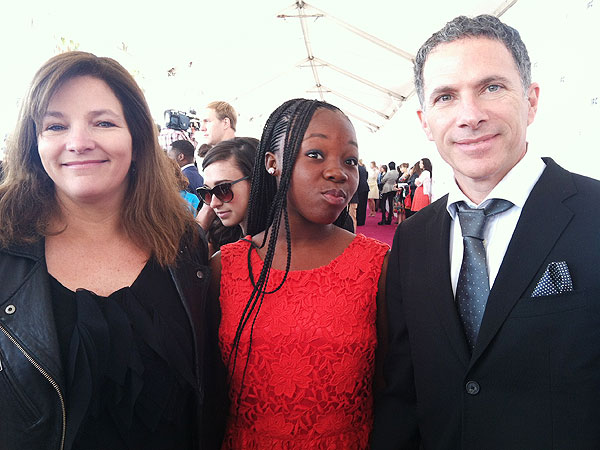
Below, see a shot of Mwanza and her War Witch producers Marie-Claude Poulin and Pierre Even at the Independent Spirit Awards, and be sure to watch her film, which will be On Demand beginning Tuesday and in select theaters March 1.


And keep an eye out for her at the Oscars Sunday night, where she’ll be wearing a top-secret dress made for her by an African designer. Can’t wait to see her poses!


Oscars 2013 Rachel MwanzaCourtesy Rachel Mwanza


–Alex Apatoff


PHOTOS: SEE MORE OSCARS STYLE HERE!


Read More..

Paying People to Play Video Games


House Speaker John Boehner tweets that the Obama administration is spending $ 1.2 million “paying people to play video games.” That’s misleading. The government did pay $ 1.2 million for university research that includes the study of how video games can stimulate the cognitive abilities of seniors. A fraction of that cost went to compensate seniors who participated in the study, researchers say.


Boehner was one of several prominent Republican congressmen who sent out a flurry of tweets – hashtag #cutwaste – distorting the research. Some Republicans said the money was spent to play the video game World of Warcraft. That’s wrong. World of Warcraft is not part of research funded by the federal government, although the study does use, in part, the Wii game Boom Blox.


We take no position on whether spending $ 1.2 million studying ways to improve the cognitive abilities of seniors is a waste of taxpayer money. But the Republicans should call it what it is and not distort the facts – even if they get only 140 characters to make their case against it.


But before we get into the facts of the research project, let’s dissect the anatomy of this Republican talking point.


The first volley in the “World of Warcraft” Twitter campaign appears to have come from House Majority Leader Eric Cantor on Feb. 19.


Cantor, Feb. 19: President Obama wants to raise your taxes so he can pay people $ 1.2 million to play World of Warcraft. http://1.usa.gov/Y3NGOH


The link goes to a press release from Cantor’s office listing a number of examples of “federal government waste,” including: “The National Science Foundation spent $ 1.2 million paying seniors to play ‘World of Warcraft’ to study the impact it had on their brain.” That’s not exactly right, but even that incomplete description gets further distorted in a series of tweets from Cantor and other House Republicans on Feb. 20.


Cantor, 10:56 a.m.: Federal Government spends $ 1.2 million paying people to play World of Warcraft video games. Instead of raising taxes, let’s #CutWaste


Speaker John Boehner, 10:57 a.m.: Pres Obama wants more tax hikes, refuses to #cutwaste like $ 1.2M spent paying people to play video games #Obamaquester


GOP Whip Rep. Kevin McCarthy, 11:01 a.m.: Not a kid’s fairytale: fed gov’t actually pays ppl w taxpayer dollars to play video games. Time to #CutWaste. http://1.usa.gov/Y3NH4U


Rep. Ann Wagner, 11:01 a.m.: Did you know the govt paid $ 1.2 million to pay people to play World of Warcraft? http://tinyurl.com/bg8njug Instead of tax hikes #CutWaste


Rep. Diane Black, 11:03 a.m.: Waste of the Day: $ 1.2 million tax dollars used to pay people to play World of Warcraft http://bit.ly/UIG5oK #CutWaste don’t raise taxes


Rep. Renee Ellmers, 11:08 a.m.: Tax dollars at work: govt paid $ 1.2 million to study seniors playing World of Warcraft http://tinyurl.com/bg8njug Instead of tax hikes #CutWaste


Rep. Darrell Issa, 11:46 a.m.: That awkward moment when @BarackObama says “We don’t have a spending problem” then it comes out the Gov paid $ 1.2 mil to play video games…


Rep. David McKinkley, 12:15 p.m.: Did you know the govt paid $ 1.2 million to pay people to play World of Warcraft? http://tinyurl.com/bg8njug Instead of tax hikes #CutWaste


How did this research grant suddenly become the poster child for government waste? It traces its roots to “Wastebook 2012,” Sen. Tom Coburn’s list of 100 wasteful government expenditures. The project in question was No. 87.


Coburn, Wastebook 2012: 87) Should grandparents play World of Warcraft ? — (NC) $ 1.2 million


Soon, grandma may have to skip dinner to join her World of Warcraft guild in a dungeon raid. Researchers believe they have found another means to help our memories as we age: the “World of Warcraft,” a fantasy video game featuring characters like orcs, trolls, and warlocks. The team of academics used part of $ 1.2 million in grants from the National Science Foundation to continue a video game study this year.


The study asked 39 adults ages 60 to 77 to play “World of Warcraft” for two hours a day over two weeks. In the game, players choose a character and rove around the virtual world participating in guild (group) missions, casting spells, and defeating evil creatures.


Millions of people around the world play, with the average player spending almost 11 hours per week playing.


At the end of the two-week study period, researchers found no cognitive improvement in older people who already scored well on cognitive tests. People who started out with lower initial results, however, experienced some improvements.


It’s true that the National Science Foundation — using funds from the economic stimulus — funded two grants totaling $ 1.2 million to study the ways in which the use of some video games by older people can improve their cognitive and everyday abilities, such as memory and reasoning. You can read the abstracts for the two grant awards here and here.


More broadly, according to the abstract, the researchers hope to “advance the knowledge and understanding of how cognitive training reduces age-related decline.”


The project is being led by Anne McLaughlin and Jason Allaire, both at the North Carolina State University’s Gains Through Gaming Lab, which is “dedicated to conducting applied research examining the relationship between playing commercially available video games and important psychological constructs” and specifically “how video games can improve cognitive functioning.”


We spoke to McLaughlin about the way her research was being characterized by Republican leaders in the House.


“Misleading doesn’t describe it,” McLaughlin said. “It is entirely inaccurate.”


For starters, she said, the research that included the World of Warcraft game was not funded by the National Science Foundation, though it helped to set the stage for the federally funded project.


The initial study looked at the effects of playing an “attentionally demanding game” — in this case, World of Warcraft — on the cognitive abilities of seniors. For the uninitiated, World of Warcraft is a massively multiplayer online role playing game (MMORPG). (It’s the game featured in episodes of “South Park” and the sitcom “Big Bang Theory.”)


The study cost a total of $ 5,000 and was funded entirely by N.C. State, McLaughlin said. It was initiated as a pilot and showed some promising results in improving the cognitive abilities of some seniors, particularly those who scored poorly in the cognitive pre-tests. Results of this study were featured in stories by the Los Angeles Times, Time magazine and CBS News, as well as in a press release from N.C. State.


Spurred by those results, McLaughlin and Allaire sought and were awarded two grants from the NSF to perform a much larger series of studies — in part employing the interactive Wii game Boom Blox.


By manipulating various aspects of the game, they are trying to pinpoint what kinds of game play best improve cognition and functioning for older adults, McLaughlin said, as well as determining the effects of playing alone versus in groups.


That’s just the first phase. Then, in collaboration with computer whizzes at Georgia Tech, they hope to develop guidelines for games for older players that will lead to “a new class of ‘brain games’ with reliable effectiveness,” according to the abstract.


“The whole purpose of this is to generalize beyond any game and promote cognitive improvement,” McLaughlin said.


Begun in 2009, the research is still in progress, McLaughlin said.


For the record, McLaughlin said, “We don’t pay anyone to play video games. We pay them to participate in a study.”


Participants first take a three-hour cognitive test to use as a baseline. Then they are asked to come back and play a video game for an hour a day for 15 straight days. Then they are given another three-hour cognitive test immediately afterward, and then two more tests — one three months later and the last a year later. The amount of the $ 1.2 million grant money spent on paying the participants of the study is a small fraction of the overall cost, McLaughlin said.


We initially were led to the grants after making an inquiry with Cantor’s office seeking backup material for claims about the federal government spending $ 1.2 million for people to play World of Warcraft.


In addition to passing along links to the study abstracts, Megan Whittemore, Cantor’s press secretary, offered this response: “The President of the United States said he was going to have to turn criminals loose on the street. Clearly, he created a false choice between raising taxes or near-apocalyptic conditions. In reality, we need to make choices on how the federal government spends taxpayers’ hard earned dollars. While some of these programs may have some merit to some people, should they be saved before preventing the drastic scenario the President painted this week?”


Again, as independent fact-checkers, we take no position about whether these grants are a worthwhile use of taxpayer money. Cutting budget deficits — a stated goal of both Republicans and Democrats — is going to require some tough choices. But the facts simply get in the way of this Republican talking point. Paying people $ 1.2 million to play video games sounds a lot more outrageous than studying ways to improve the cognitive abilities of seniors. And it misleadingly twists what the grants are all about.


– Robert Farley


Also Read
Gaming News Headlines – Yahoo! News


Title Post: Paying People to Play Video Games
Url Post: http://www.news.fluser.com/paying-people-to-play-video-games/
Link To Post : Paying People to Play Video Games
Rating:
100%

based on 99998 ratings.
5 user reviews.
Author: Fluser SeoLink
Thanks for visiting the blog, If any criticism and suggestions please leave a comment


Read More..

Papal Conclave Accompanied by Reports of Scandals and Intrigue


Osservatore Romano/Reuters


Pope Benedict XVI, right, spoke to cardinals at the Vatican on Saturday.


VATICAN CITY — As cardinals from around the world begin arriving in Rome for a conclave to elect a successor to Pope Benedict XVI, new shadows have fallen over the delicate transition, which the Vatican fears might influence the vote and with it the direction of the Roman Catholic Church.


In recent days, often speculative reports in the Italian news media — some even alleging gay sex scandals in the Vatican, others focusing on particular cardinals stung by the child sex abuse crisis — have dominated headlines, suggesting fierce internal struggles as prelates scramble to consolidate power and attack enemies in the dying days of a troubled papacy.


The reports, which the Vatican has vehemently denied, touch on some of the most vexing issues of Benedict’s reign, including the child sex abuse crisis and international criticisms of the Vatican Bank’s opaque record-keeping. The recent explosion of bad press — which some Vatican experts say is fed by carefully orchestrated leaks meant to weaken some papal contenders — also speak to Benedict’s own difficulties governing, which analysts say he is trying to address, albeit belatedly, with several high-profile personnel changes.


The drumbeat of scandal has reached such a fever pitch that on Saturday, the Vatican Secretariat of State issued a rare pointed rebuke, calling it “deplorable” that ahead of the conclave there was “a widespread distribution of often unverified, unverifiable or completely false news stories, that cause serious damage to persons and institutions.”


The Vatican compared the news reports to past attempts by foreign states to exert pressure on the papal election, saying the latest efforts to skew the choice of the next pope by trying to shape public opinion were “based on judgments that do not typically capture the spiritual aspect of the moment that the Church is living.”


Benedict had hoped to address at least one scandal with the Feb. 15 appointment of a new head of the Vatican Bank. It is less clear why he reassigned a powerful Vatican diplomatic official to a posting outside Rome, though experts say it diminishes the official’s role in helping steer Vatican policy.


On Feb. 11, Benedict made history by announcing that he would step down by month’s end. He said he was worn down by age and was resigning “in full liberty and for the good of the Church.” The volley of news reports since appeared to underscore the backbiting in the Vatican that Benedict was unable to control, and provided a hint of why he might have decided that someone younger and stronger should lead the church.


At the conclusion of the Vatican’s Lenten spiritual retreat, Cardinal Gianfranco Ravasi, the director of the Pontifical Council for Culture and a papal contender, spoke darkly of the “divisions, dissent, careerism, jealousies” that he said plagued the Vatican hierarchy.


The recent spate of news reports were linked to an earlier scandal in which the pope’s butler stole confidential documents that was considered one of the gravest security breaches in the modern history of the church.


Last week, largely unsourced articles in the center-left daily La Repubblica and the center-right weekly Panorama reported that three cardinals whom Benedict had asked last summer to investigate the leaking of the documents, known as the “VatiLeaks” scandal, had found evidence of Vatican officials who had been put in compromising positions.


The newspapers reported that, after interviewing dozens of people inside and outside the Vatican, the cardinals produced a hefty dossier. “The report is explicit. Some high prelates are subject to ‘external influence’ — we would call it blackmail — by nonchurch men to whom they are bound by ‘worldly’ ties,” La Repubblica wrote.


Vatican experts speculated that prelates eager to undermine opponents during the conclave were behind the leaks to the news media over the last week.


“The conclave is a mechanism that serves to create a dynasty in a monarchy without children, so it’s a complicated operation,” said Alberto Melloni, the director of the John XXIII Center in Bologna and the author of a book on conclaves.


This article has been revised to reflect the following correction:

Correction: February 23, 2013

An earlier version of this article misspelled the last name of a cardinal. His name is Roger M. Mahony, not Roger M. Mahoney.


Read More..

Eric Garcetti's role in L.A. budget fixes is in dispute


Pressed in the race for mayor of Los Angeles to say how he would fix a persistent budget gap that has led to the gutting of many city services, Eric Garcetti urges voters to look at what he has done in the past.


The onetime City Council president claims credit for reforms that he said cut the City Hall shortfall to just over $200 million from more than $1 billion. He sees "tremendous progress," principally in reducing pension and healthcare costs, and asserts: "I delivered that."


But the truth is in dispute. Although there is not a singular view about any aspect of the city's troubled finances, most of those in the thick of recent budget fights depict Garcetti not as a fiscal hard-liner but as a conciliator who used his leadership position to chart a middle ground on the most significant changes.


Mayor Antonio Villaraigosa, city administrative officer Miguel Santana and one of Garcetti's rivals in the mayoral race, Councilwoman Jan Perry, were among those who pushed for bigger workforce reductions and larger employee contributions toward pensions and healthcare. Labor leaders and their champions on the City Council, including Paul Koretz and Richard Alarcon, sought to cushion the blow for workers.


Garcetti and his supporters say he moderated between those extremes. His critics said he worried too much about process and airing every viewpoint rather than focusing relentlessly on shoring up the city's bottom line.


"It was through the mayor's persistence and steadfast position that we got ongoing concessions," said Santana, the chief budget official for Los Angeles. "It was in collaboration with the council leadership that we finally reached agreements with labor."


The $1-billion-plus deficit Garcetti speaks of shrinking refers not to a single year but to the total of budget gaps that confronted Los Angeles over four years if no corrective action had been taken. The city's fiscal crisis worsened during that time because Garcetti and his fellow council members — including Perry and mayoral candidate Wendy Greuel — approved a city employee pay raise of 25% over five years just before the country stumbled into the recession. (Greuel left the council in 2009 when she was elected city controller.)


Although Garcetti focuses on his role, a portion of the financial improvements were outside his control. The state's elimination of redevelopment agencies in 2012 returned millions to L.A.'s general fund. Tax revenue also ticked upward with the economic recovery.


Garcetti's position as council president from 2006 through 2011 did put him at the center of debate about annual shortfalls that ranged to more than $400 million.


In 2009, he supported an early retirement plan that knocked 2,400 workers off the payroll. "I really pushed that through," the councilman said in an interview. Two participants in confidential contract talks at the heart of the deal had diametrically opposed views. "He made it happen, period," one said; the other offered: "I wouldn't say he was a major mover."


The plan saves the city a maximum of $230 million a year in salary and pension reductions in the short run. But Los Angeles borrowed to spread the costs of the program over 15 years, with current employees and retirees expected to shoulder the cost of the early exits.


The early retirements are expected to do nothing to resolve the long-term "structural deficit" — the $200 million to $400 million a year that Los Angeles spends above what it takes in. And early retirements could even be a net negative in the long run if, as city revenue recovers, new employees are put in those 2,400 empty positions too quickly.


In 2010 the city completed a budget fix that did attack the structural imbalance.


Garcetti's initial proposal called for upping the retirement age for new city employees to 60 from 55 and requiring workers to contribute a minimum of 2% of salary toward their retiree health care.


Budget chief Santana offered a markedly tougher plan. It required a 4% retiree health contribution, halved the health subsidy for retirees and capped pension benefits at 75% of salary instead of 100%. Santana's plan, also for new employees, became the basis of the reform.


Some who served with Garcetti on the council committee that leads employee negotiations pushed for even greater sacrifices. But Garcetti fought against ratcheting up demands on workers, saying it would be useless to approve a plan that would not survive subsequent union votes.


The councilman's greatest contribution may have come after city leaders set their position on pensions. Garcetti took the unusual step of visiting groups of workers. Some employees booed. Some asked him why city lawmakers, among the highest paid in the nation at $178,000 a year, didn't cut their own salaries.


"There was a lot of anger," said a labor leader who spoke on condition of anonymity because that union has not endorsed in the race. "But Eric talked to people as if they were adults and stayed until he answered all their questions. People appreciated him ... taking that kind of heat."


Matt Szabo, a former deputy mayor who helped negotiate with labor, said Garcetti deserved "every bit of credit" he has claimed for deficit reduction. "He knew he was running for mayor, and he was doing the right thing, but it was something that was going to cost him later" in terms of union support, said Szabo, who is running to replace Garcetti on the council.


Most of the employee groups that have endorsed thus far in the mayor's race have come out for Greuel. One political advantage for the controller: She left the council in 2009, before the city began making its toughest demands on workers.


Garcetti found himself stuck the middle again with another 2010 vote, this one over the elimination of 232 jobs — most of them in libraries and day care operations at city parks. Garcetti voted for the layoffs. Later he voted to reconsider, though he said recently that he intended only to re-air the issue, not to keep the workers on the job.


Labor leaders faulted Garcetti for giving the appearance he might be ready to save the jobs when he really wasn't. The reductions remain a sore point, because a "poison pill" in the contract required that any layoffs be accompanied by immediate pay raises for remaining city employees. Fierce disagreement remains over whether the layoffs saved the city any money.


"That became part of the negative picture" of Garcetti, said one labor leader, who asked not to be named out of concern about alienating a possible future mayor. The candidate said in an interview that he frequently found himself hewing a middle ground between some colleagues "who simply hope more revenue would come in" and others who wanted to use an "ax," making indiscriminate cuts. He added: "To me, both views were equally unacceptable."


Critics find Garcetti too malleable, ready to shift to the last argument he has heard. But others appreciate his quest for the middle, saying the fact he sometimes irritated both budget hard-liners and unions showed he had taken a reasoned approach.


"The criticism of Eric is also sort of the good news," said one of the union reps. "He has this very process-y, kumbaya, can't-we-all-get-along style. It drove us all crazy. But now I really miss it because it seems to be all politics over policy."


james.rainey@latimes.com


Read More..

FDA approves new targeted breast cancer drug


WASHINGTON (AP) — The Food and Drug Administration has approved a first-of-a-kind breast cancer medication that targets tumor cells while sparing healthy ones.


The drug Kadcyla from Roche combines the established drug Herceptin with a powerful chemotherapy drug and a third chemical linking the medicines together. The chemical keeps the cocktail intact until it binds to a cancer cell, delivering a potent dose of anti-tumor poison.


Cancer researchers say the drug is an important step forward because it delivers more medication while reducing the unpleasant side effects of chemotherapy.


"This antibody goes seeking out the tumor cells, gets internalized and then explodes them from within. So it's very kind and gentle on the patients — there's no hair loss, no nausea, no vomiting," said Dr. Melody Cobleigh of Rush University Medical Center. "It's a revolutionary way of treating cancer."


Cobleigh helped conduct the key studies of the drug at the Chicago facility.


The FDA approved the new treatment for about 20 percent of breast cancer patients with a form of the disease that is typically more aggressive and less responsive to hormone therapy. These patients have tumors that overproduce a protein known as HER-2. Breast cancer is the second most deadly form of cancer in U.S. women, and is expected to kill more than 39,000 Americans this year, according to the National Cancer Institute.


The approval will help Roche's Genentech unit build on the blockbuster success of Herceptin, which has long dominated the breast cancer marketplace. The drug had sales of roughly $6 billion last year.


Genentech said Friday that Kadcyla will cost $9,800 per month, compared to $4,500 per month for regular Herceptin. The company estimates a full course of Kadcyla, about nine months of medicine, will cost $94,000.


FDA scientists said they approved the drug based on company studies showing Kadcyla delayed the progression of breast cancer by several months. Researchers reported last year that patients treated with the drug lived 9.6 months before death or the spread of their disease, compared with a little more than six months for patients treated with two other standard drugs, Tykerb and Xeloda.


Overall, patients taking Kadcyla lived about 2.6 years, compared with 2 years for patients taking the other drugs.


FDA specifically approved the drug for patients with advanced breast cancer who have already been treated with Herceptin and taxane, a widely used chemotherapy drug. Doctors are not required to follow FDA prescribing guidelines, and cancer researchers say the drug could have great potential in patients with earlier forms of breast cancer


Kadcyla will carry a boxed warning, the most severe type, alerting doctors and patients that the drug can cause liver toxicity, heart problems and potentially death. The drug can also cause severe birth defects and should not be used by pregnant women.


Kadcyla was developed by South San Francisco-based Genentech using drug-binding technology licensed from Waltham, Mass.-based ImmunoGen. The company developed the chemical that keeps the drug cocktail together and is scheduled to receive a $10.5 million payment from Genentech on the FDA decision. The company will also receive additional royalties on the drug's sales.


Shares of ImmunoGen Inc. rose 2 cents to $14.32 in afternoon trading. The stock has ttraded in a 52-wek range of $10.85 to $18.10.


Read More..

The Hunger Games: Katniss & Peeta's Victory Tour Look Revealed


02/22/2013 at 06:00 PM EST


They survived the Hunger Games – but will they survive the Victory Tour?

Sporting bridal-like attire, Katniss (Jennifer Lawrence and Peeta (Josh Hutcherson) pose for a promotional poster for the Victory Tour – which – in the Hunger Games universe – is when the victor of the annual Hunger Games tournament visits each of the fictional Panem's districts.

As true Hunger Games fans know, there is usually only one victor – but Katniss and Peeta rebelled against the Capitol in the first movie, originally opting for joint suicide instead of murder.

The softer look is a deliberate statement, meant to continue the charade that Katniss and Peeta were blinded by love when they rebelled against the rules in the arena.

The second film, Catching Fire, hits theaters Nov. 22.

Read More..